Built to hold through any market, grounded in a century of evidence.
Trust is earned, not claimed. These are the six principles the portfolio is built on, drawn from decades of research and a century of market data. They are the cornerstone of how your money is managed, so you can stay confident in your plan through whatever the markets do.
The principles
Six, in order.
01
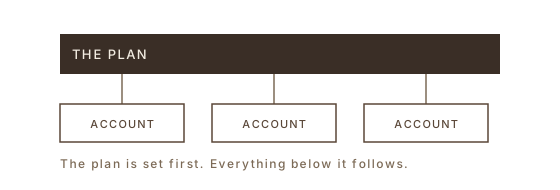
The financial plan drives the portfolio, not the other way around
The portfolio funds a life you’ve already described. Until the financial plan says what the money is for and when it’s needed, there’s no way to know what risk is appropriate.
For youWe won’t discuss investments in the first meeting. We’ll discuss the financial plan.
02
Evidence over prediction
Forecasts sell newsletters and don’t survive contact with reality. Decisions here rest on long-run evidence about how markets compensate risk, not a view on next quarter.
For youYou’ll never get a call telling you to get out of the market.
03
Portfolio construction is science, not speculation
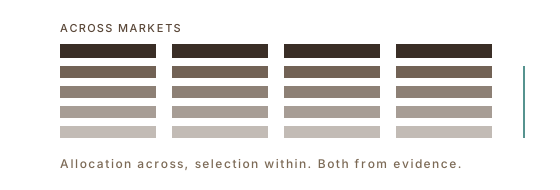
Two decisions do most of the work: asset allocation (how the money is spread across markets and asset classes) and security selection (what you hold within each). Both rest on long-run evidence about how markets reward risk, not a bet on what comes next. Diversification runs across countries, asset classes and factor exposures, using a scientific approach.
For youYour portfolio is engineered from evidence, not assembled from predictions.
04
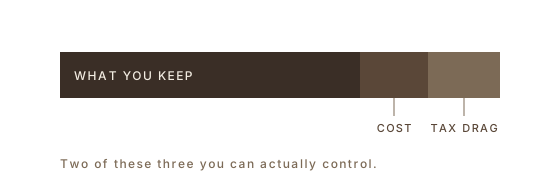
Cost and tax drag are the part you can control
Returns are not in anyone’s hands. What you pay to invest, and what the tax system takes on the way through, largely are.
For youEvery cost gets named, including mine.
05
Where an investment sits matters as much as what it is
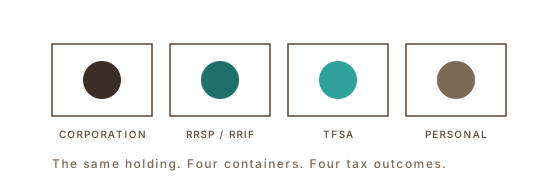
The same holding is taxed differently in a corporation, an RRSP or RRIF, a TFSA, and a personal account. Deciding what goes where, and later what comes out first, is where most of the recoverable value is, and it’s the part generic advice skips entirely.
Why you’re hereThe one principle that does heavy work for owners and retirees alike.
06
Behaviour is the biggest single risk to a good financial plan
Most financial plans fail at the moment of abandonment, not in the spreadsheet. Part of the job is being the person you call before you do something you’d regret.
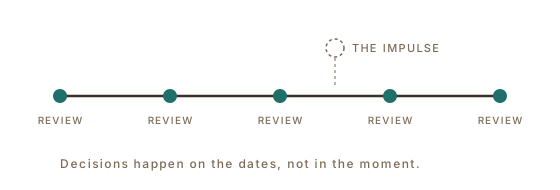
For youThe review schedule exists so decisions get made calmly, on a date.
The foundation
Built on evidence, not opinion.
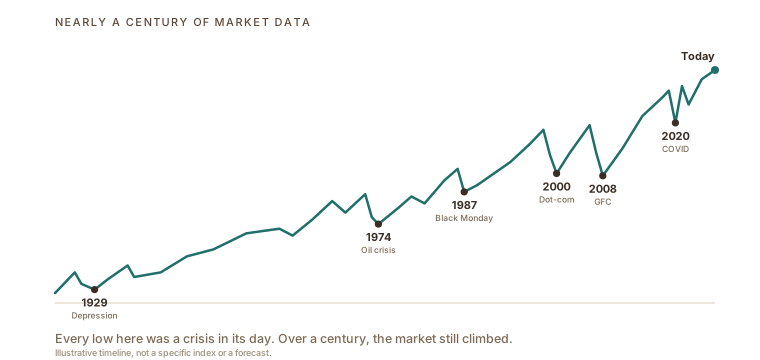
None of this is invented in-house. It rests on financial science: decades of peer-reviewed research and nearly a century of market data, tested across countries, asset classes and market conditions.
The core ideas are not matters of opinion: that markets do a remarkably good job of pricing in what is known, that risk and expected return are related, and that broad diversification beats forecasting. They come from work that earned the Nobel Prize in economics, and they have held up in the decades since.
That is why the portfolio is engineered rather than guessed at. Rather than trying to outguess millions of other investors, it draws on the information already reflected in prices and leans toward the characteristics that research has consistently linked to higher expected returns. Those are expectations grounded in evidence, never guarantees. A scientific, evidence-first approach, applied to your financial plan.
Beyond indexing
Why not just buy the index?
A low-cost index fund is a perfectly reasonable default, and it beats most actively managed funds that try to pick winners. Low cost and broad diversification are exactly right. The real question is whether you can keep those strengths and still do a little better than a plain index.
An index is a commercial product with rules. A fund tracking it has to hold the named securities and trade them on set reconstitution dates, at the same time as everyone else tracking the same benchmark. That rigidity carries a cost: forced buying and selling on the calendar, at prices that move against you because the trades are announced in advance.
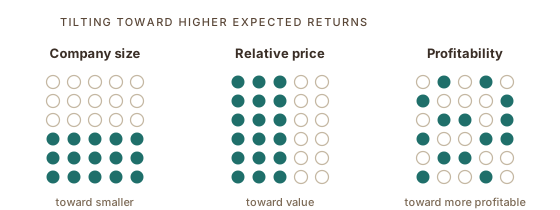
A systematically managed, low-cost fund keeps the cost discipline of indexing but drops the rigidity. Because it isn’t chained to a benchmark, it can trade patiently instead of on a fixed date, and it deliberately tilts toward the characteristics research links to higher expected returns: company size, price relative to fundamentals, and profitability. A cap-weighted index holds those only by accident.
“Active” here doesn’t mean forecasting or stock-picking. It means disciplined, daily implementation of the evidence, with a constant eye on cost and tax. The goal is the low cost of indexing without its blind spots. None of this promises to beat the market in any given year. Expected returns are expectations, not guarantees. But it is why the portfolios lean this way rather than to a plain index.